I can’t say for sure how long I’ve been using Perplexity.
It started as an app on my phone that I rarely used. But at some point in the past 6-8 weeks, I started using it more.
And now I use Perplexity daily.
When I first started using Perplexity, I was annoyed by the news links under the prompt box.
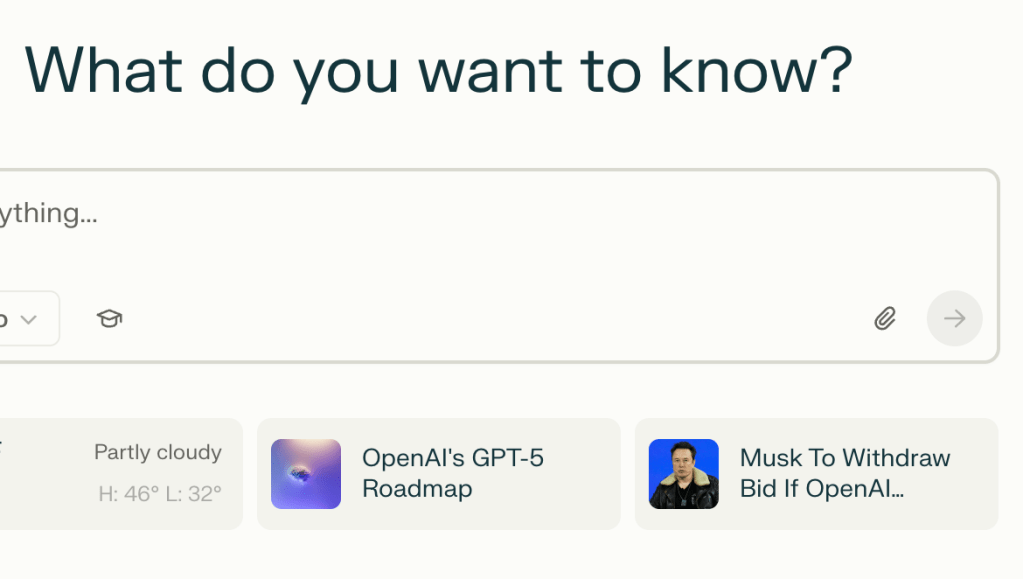
It distracted me. And took me away from my purpose in using Perplexity, in my opinion.
However, as I think about it today, I see how it highlights one of Perplexity’s biggest competitive advantages: access to real time data via the internet.
Yet, up until yesterday, I am pretty sure I had never clicked any of these links.
But yesterday, a headline caught my eye.
Microsoft Study: AI Impairs Critical Thinking
Huh, I thought. I was curious. So I clicked. And I am glad I did.
It was interesting to see how the article was laid out.
Perplexity created a template: first they give a quick TLDR summary, they show you the sources that were used to write the article, and then they break the article down into 4 easily digestible bits of information. As a result, the information was easy to navigate and retain.
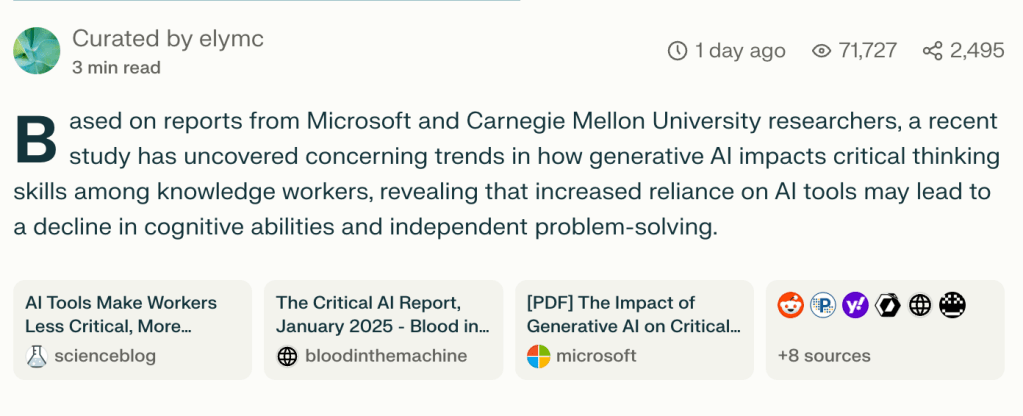
Bravo Perplexity! Great UX.
But back to this specific article: Microsoft Study: AI Impairs Critical Thinking.
Working with AI and being confident in my critical thinking ability, I was curious about the subject.
And I wondered: how could AI impact or cause me to lose this valuable skill?
Right off the bat, my eyes slowed as they read:
“… increased reliance on AI tools may lead to a decline in cognitive abilities and independent problem-solving.”
That is troubling. But as I thought about it critically, I understood it.
Claude took a task, that would have taken me months, and created a sound plan in a matter of minutes.
Had the process ended there, I see the potential risk.
Yes, I had to think critically about my prompt to Claude, but beyond that, Claude did the rest.
If this is how we use generative AI, then yes, critical thinking will be used less and less.
BUT, if we use AI output as a starting point, and then evaluate it, we can then modify and iterate from there. This will allow us to use critical thinking.
And I think that is the answer. This is how we retain critical thinking skills while working with generative AI.
Critical thinking is applied at the beginning with the initial prompting. And then critical thinking is applied again once AI output is produced.
Candidly, this article shook me a little bit. After considering it, I understood the risk posed with leveraging generative AI.
The best path forward: use critical thinking as often as possible and exercise the muscle.
Right now, I thought. Let’s go.
So, I went to Claude.

I wasn’t sure what Claude would work up for me, but I was confident it would be a fruitful exercise.
And Claude delivered.
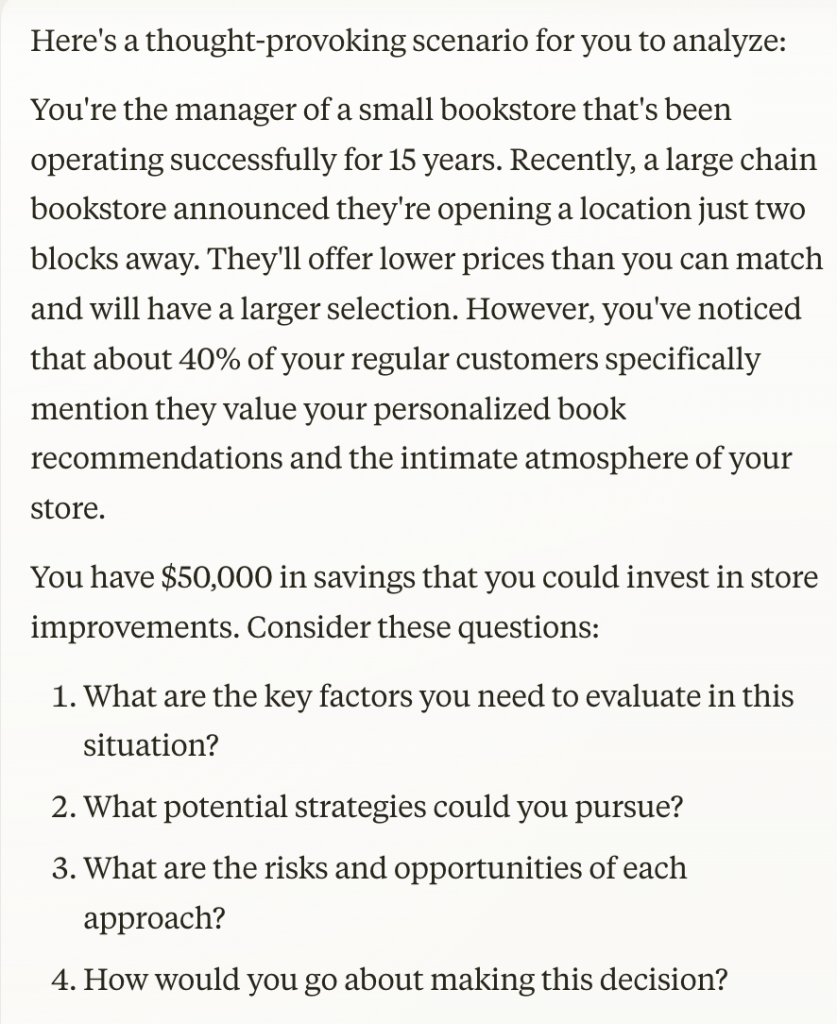
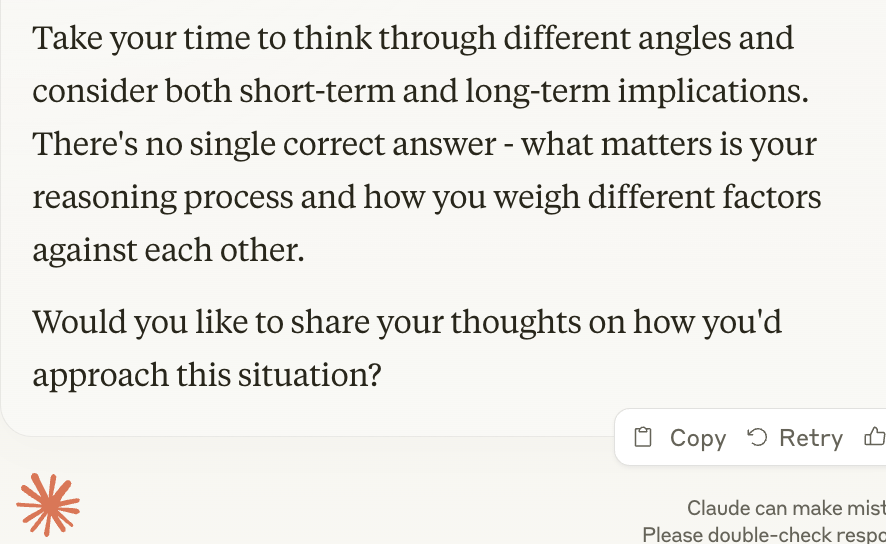
Now I will admit, in my mind Claude was going to give me a quick exercise. I was thinking 5 Min w AI here.
So when I read this, I thought wow, this is not a 5 min exercise.
But I also thought, yeah, I’ve got this.
I would then spend the next 1-2 hours working on this exercise.
(Candidly, I have no idea how long it took, I was immersed in a flow state and lost track of time!)
As I first jumped into the exercise, tbh I felt friction.
Given the structure of this exercise and the 4 questions presented, how do I address all point accordingly and fully.
But I pushed through it by jotting down notes as I read the exercise again a few more times.
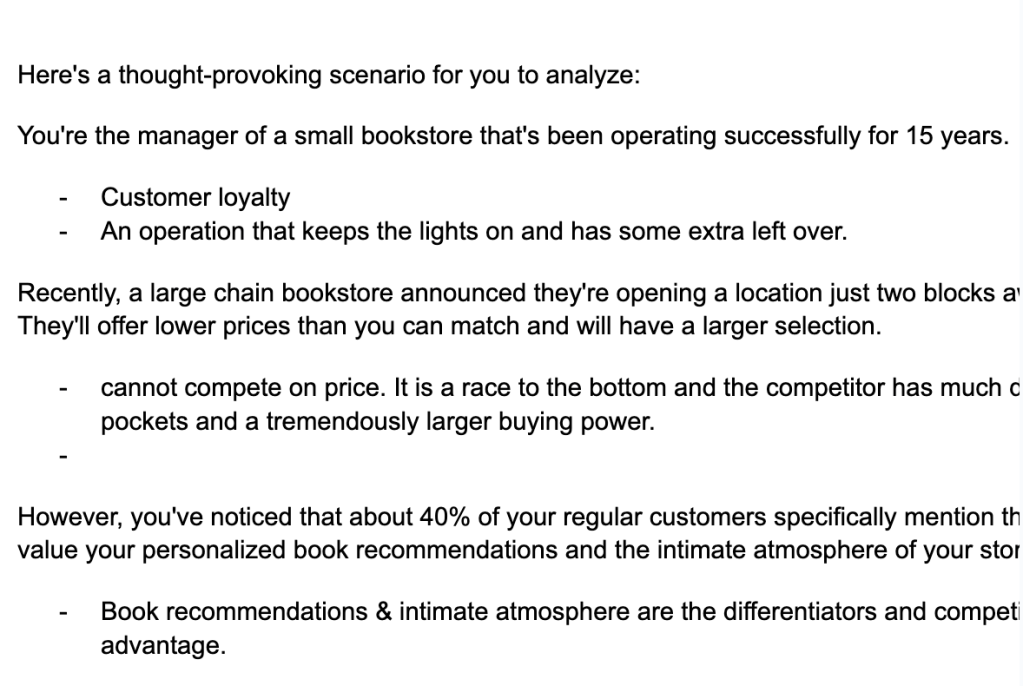
I began to formulate my plan from there, jotting notes under each question outlining my ideas.
From there, I went through each question 1 at a time and and built my responses and strategy out from there.
It was fun to consider the variety of strategies I could pursue.
My full reply ended up being 3 pages.
Proud of the effort I had put into this exercise, I was excited to see Claude’s assessment of my plan.
I entered my prompt, added the file, and hit the orange send button.
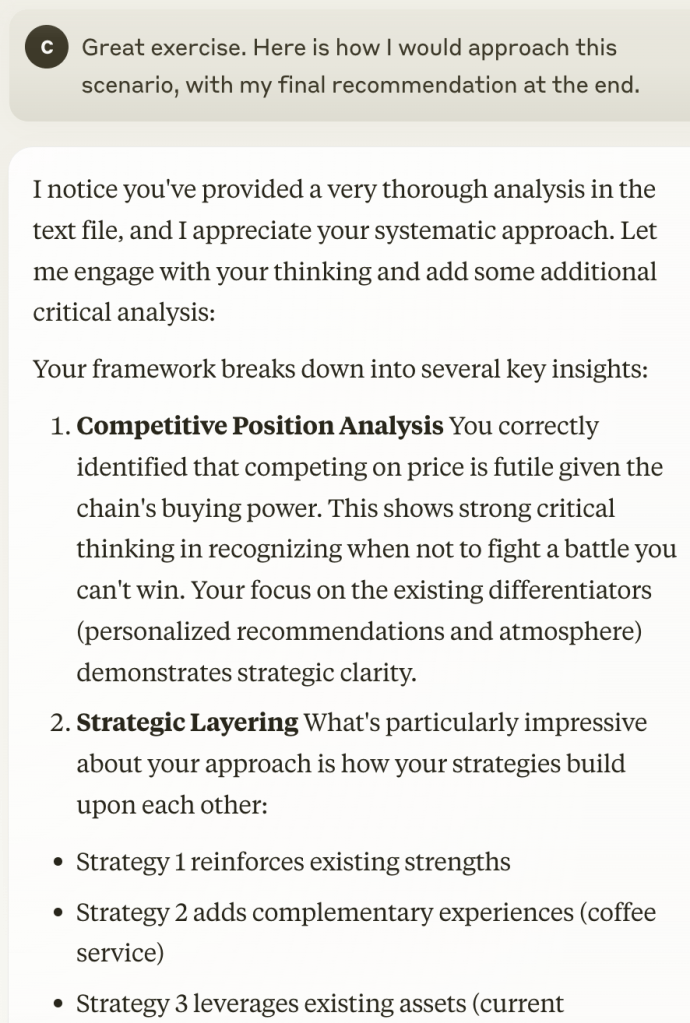

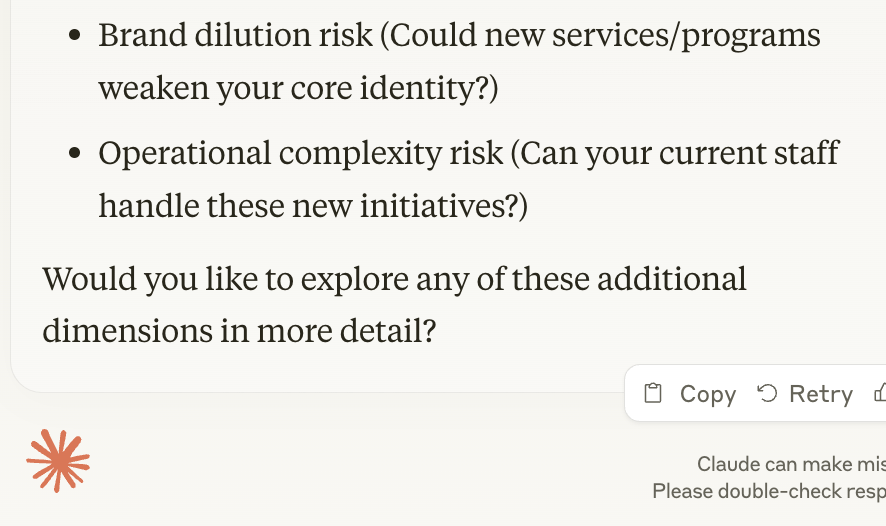
It was insightful to read Claude’s response here.
Claude summarized my ideas and agreed with a lot of what I said. But Claude also prompted me with a few follow up questions and shined light on potential gaps in my analysis.
THIS IS SO HELPFUL! I thought.
As I read Claudes suggestions for further analysis development, I was nodding my head, yeah that makes sense, that makes sense, yeah, I considered that, yeah that makes sense.
And I got excited!
Claude wasn’t killing my critical thinking; Claude was enhancing it.
Question for the audience: How else can we preserve critical thinking as AI gains widespread adoption?
 Conversating Claude
Leave a comment