The most exciting prospecting I’ve ever done took 80 minutes and 17 seconds. And I was asleep for most of it…
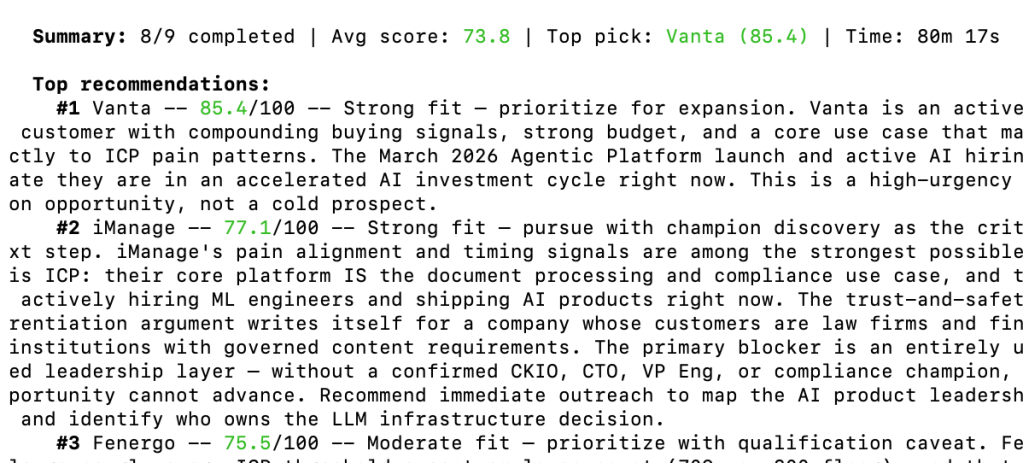
Last week, before bed, I typed /batch-research into my computer, hit ‘return’, and went to bed. When I woke up, I had a list of 8 prospects, scored and ranked based on a readiness-to-buy analysis, with recommended next steps for each.
This didn’t require a late night Sunday research session, or toggling between dozens of tabs in Chrome, or hunting for Linkedin posts to shape my research, nor an eye blurring spreadsheet trying to capture all of it.
Instead, I typed a few letters into my computer, closed my eyes, and when I came back had a verified prospect list, actionable intel, and suggested next steps.
How is this possible?!
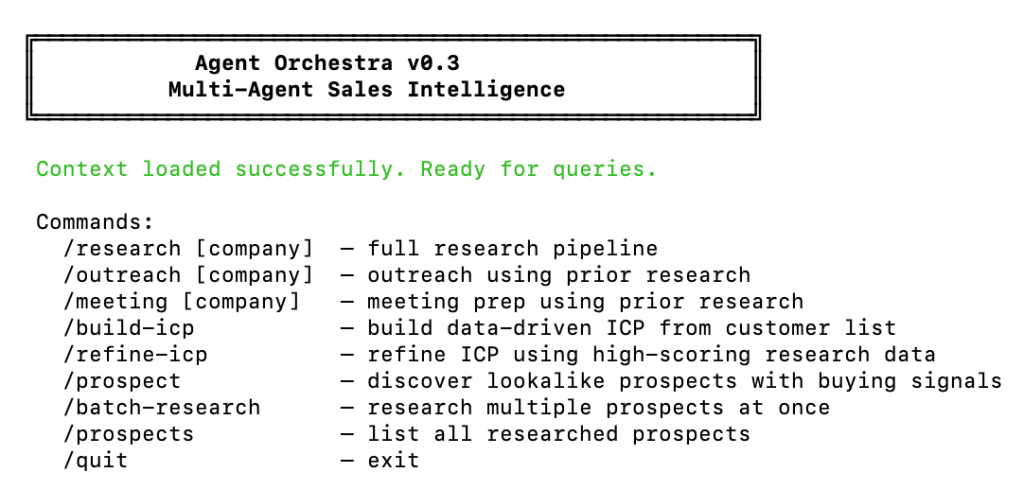
I built a 12-agent AI sales team on top of Claude SDK that takes real customer data, builds an Ideal Customer Profile, finds look-a-like prospects, researches the matching prospects in-depth, and creates tailored outreach.
I call it my Sales Agent Orchestra.
Before I go deeper, I want to answer the question:
Chase, why did you build this?
Simply put, I built the Sales Agent Orchestra because I was curious to see what was possible given the powerful capacity of AI at this exact moment in time. I wanted to apply AI to a process that I intuitively and deeply understand, and one where I understand the points of friction.
Most salespeople want to spend more time in front of their customers. They recognize that this is their highest value task. And one that ultimately moves the needle and is the difference between exceeding or missing their quota. However, low-value & admin tasks eat up a significant portion of their time.
And given where AI technology is today, I believe the sales process is ripe for disruption. I am excited to reimagine what is possible!
Okay, now that you understand why I built it, let me explain what it does.
Phase 1 consisted of building a process that utilized 12 specialized agents that went from Customer List to a personalized Cold Email awaiting final approval in my Gmail Drafts folder.
Each agent has a specific task that it takes on in various workflows of the early sales process.
Meet the Team
The conductor (Max) manages the team ->
The intelligence layer (Profiler, Prospector, Scout) handles research ->
The validation layer (Vera, Veri, Arbiter) fact-checks and acts as guardrails to hallucinations ->
The strategy layer (Quinn, Sage) leverages validated context to create strategy ->
The execution layer (Archer, Blair) draft emails and meeting prep notes ->
The final quality gate (Sentinel) scrutinizes the final output checking for coherence and looking for drift before giving it back to me.
Putting all of that together, it is a powerful sales agent team. But, how does it help me spend more time in the room with my customers?
Let’s go back to where this post began: the research. If you have been using AI (LLMs) over the past year, you surely know that they are really good at doing deep research across the web.
So how can this help me sell?
AI has the capacity to take on some of the more time consuming and repetitive tasks that are critical to the sales process, yet take a ton of my time.
Researching a prospect.
Researching an existing customer for expansion opportunities.
Prepping for a meeting with the latest prospect or customer intelligence (it can change daily!).
All of these things can be handled by AI.
Further, AI agents leveraging high intelligence models (e.g. Opus 4.6) have the ability to spot patterns across a massive data set. A well-trained salesperson can do a great job spotting patterns in their customer data, but there is a limit to how much data they can reasonably consider at a time. My brain can only consider so many things at once, but AI has massive context windows and can look at a much broader dataset to spot patterns.
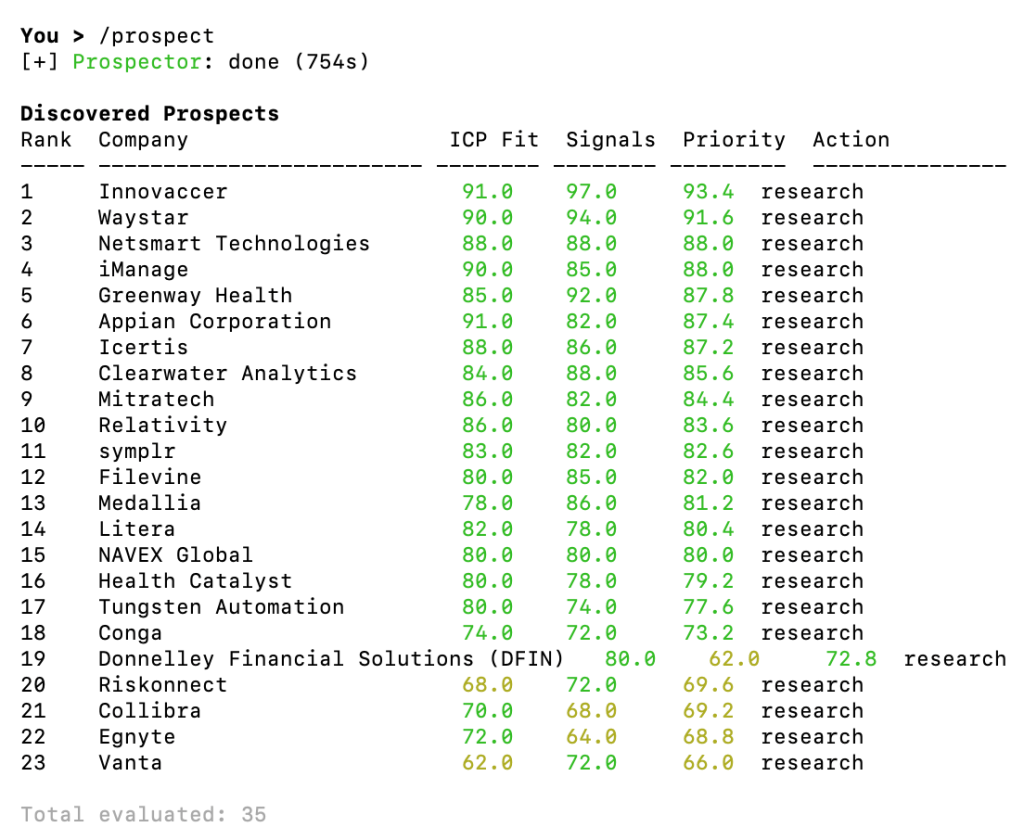
Looking at this in practice, I wanted to build out an Ideal Customer Profile (ICP) for Mid-Market “Industry” companies that had purchased AI solutions. So, leveraging a list of real customers, my Profiler agent conducted deep research on a list of 23 mid-market “Industry” companies, identified that a key pain point was unstructured document processing (64% of customers), and discovered new buyer personas (Chief Knowledge Officer & Chief Intelligence Officer) that weren’t in my original ICP. This demonstrated pattern recognition across a massive dataset that would take a human many hours (and a lot of coffee) to uncover. My Sales Agent Orchestra did all of this in about 20 minutes.
But how do I know the AI output is accurate?
If I left it to chance, I wouldn’t. But by operating with the mindset that AI can and will make mistakes (it will hallucinate), I can build architecture to mitigate this risk. And that is exactly what I did here.
Deep research, while extremely powerful, can still make things up for a variety of reasons (misinformation, misattribution, uncertainty, etc.). Agents doing research need guardrails built-in to guide them when they are unsure of something or to push for data validation.
Knowing this, I spent a lot of time researching best practices and carefully planning this next stage of the process. This led me to create a 3-agent-layer of validation.
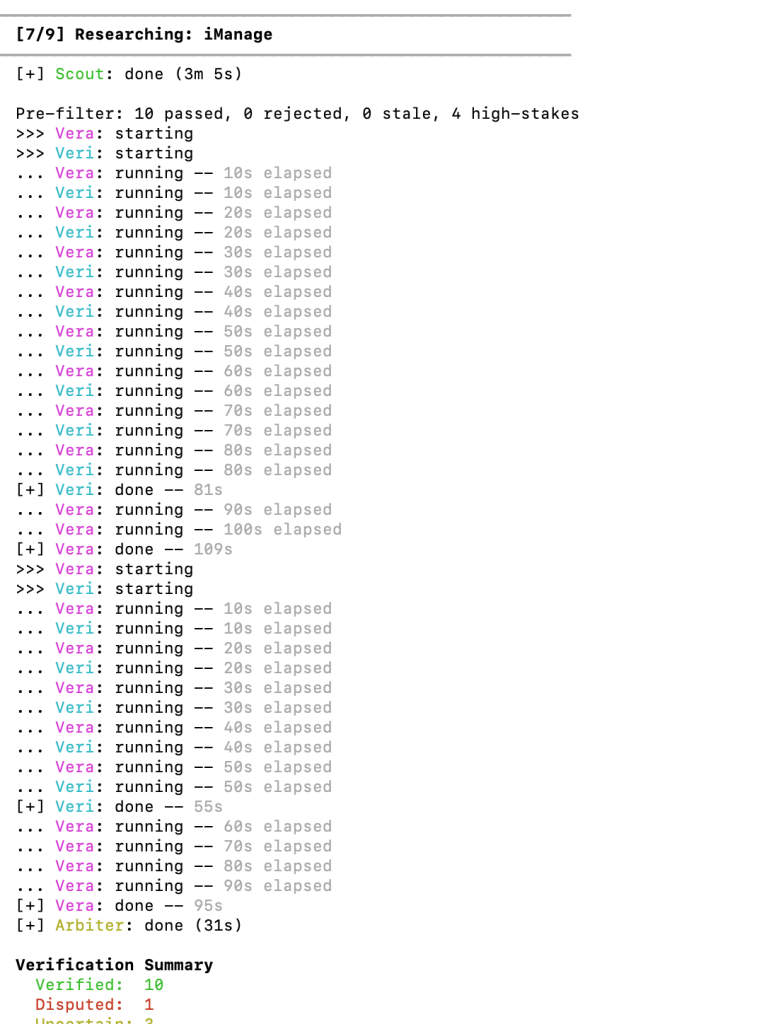
Here is how it works: Once the research agent completes its work, it passes its analysis (output) to the validation layer. Two agents (Veri & Vera) then validate all claims independently.
Vera evaluates: “does the source actually say what the claim says it does?” It has access to websearch and goes out to verify all claims at the source.
Veri evaluates: “does this claim make sense given everything we know?” It does not have web tools, only reasoning capability.
Once completed, they compare notes. If there is disagreement on any claims they go through 2 rounds of debate, arguing why their respective position is accurate. If they are able to agree based on their logic, the claim passes. And any claims where they cannot agree pass on to a third and tiebreaker agent (Arbiter). Acting as the mediator and judge, Arbiter reviews both sides and chooses the one with the highest probability of being correct.
Without this, the system can present claims that don’t actually align with what the sources say. This forces validation of each claim.
Okay, the data is validated, what happens next?
The validated context is delivered to the strategy layer. Quinn looks at each prospect reviewing the verified claims that it has been given. And it decides: is this prospect worth engaging? It looks at buying signals, measures it against the ICP, and assigns it a score based on what it finds. And it also creates a short paragraph of context sharing its reasoning for the score.
Once the entire batch, in this case 9 prospects, completes, Quinn creates a report that shows “Batch Results Complete” ranking each prospect, showing the # of claims it evaluated, the score it assigned each, and a recommendation for each prospect’s fit and how to engage. And underneath that it creates an in-depth recommendation for the top 3 prospects.
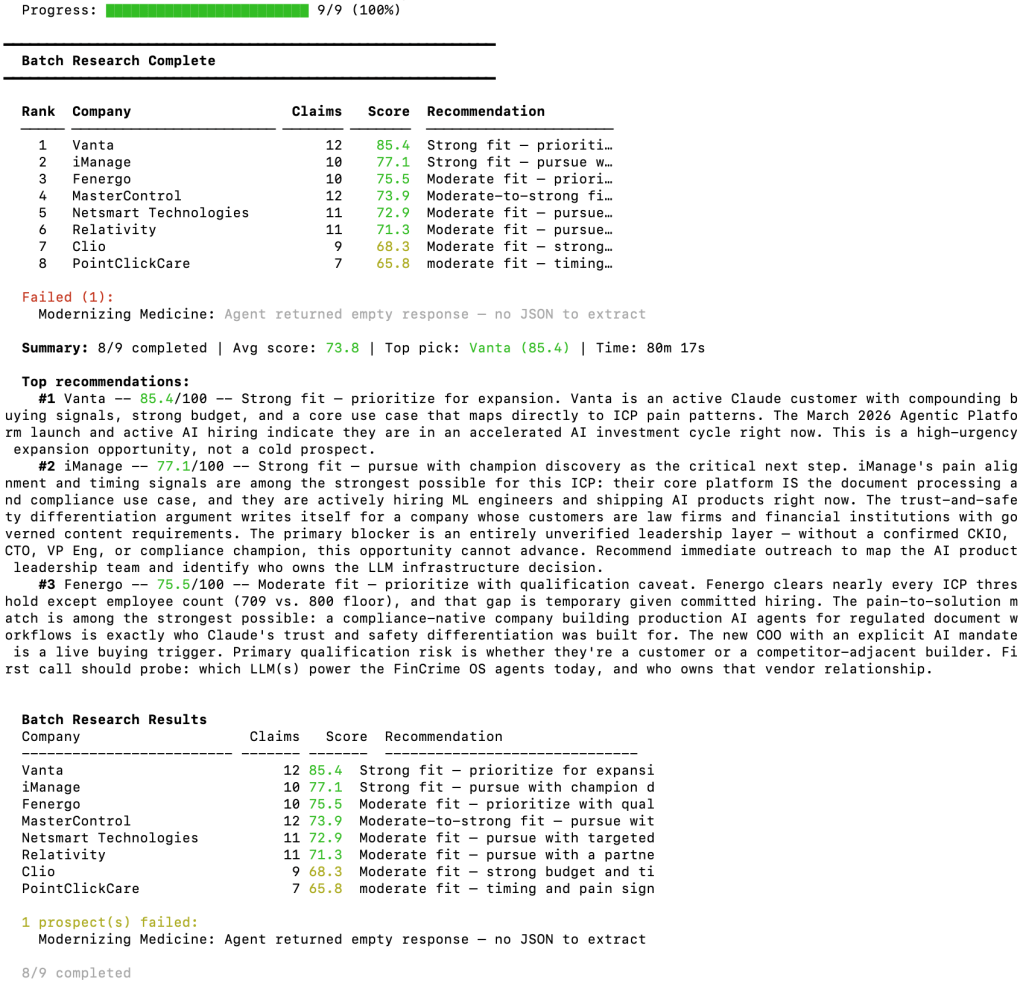
So the top prospect identified is a company called Vanta. They scored 85.4 / 100. Can I take this and go a step further?
Absolutely!
Typing /outreach Vanta into my computer kicks off a process that pulls saved context (each prospect has its own .md record in my files) and feeds it to the next agent, Sage. Sage then strategizes the proper framing and context to engage the specific prospect.
Once complete, Sage sends that context to Archer. It is now Archer’s job to figure out how to craft the perfect email to send as a cold email to someone at Vanta.
As I was building this step, I fully understood that telling AI to write a cold-outreach email without any further context would create a weak output. So, I opted to create a skill that I felt would help.
I am a big fan of Samantha McKenna’s Show Me You Know Me cold-email strategy, so I created a cold_email skill. I had Claude go out and research the SMYKM method and create the skill from scratch. And I gave Archer access to that skill.
So back to Sales Agent Orchestra, Archer spends 1 minute and 45 seconds doing some basic outreach (looking for a specific person to engage) and writes a tailored subject line and email after first determining who to send it to.
The following words appeared on my screen: “Gmail draft created: “Incident Postmortems + Agentic Trust” → (no recipient — fill in manually).”
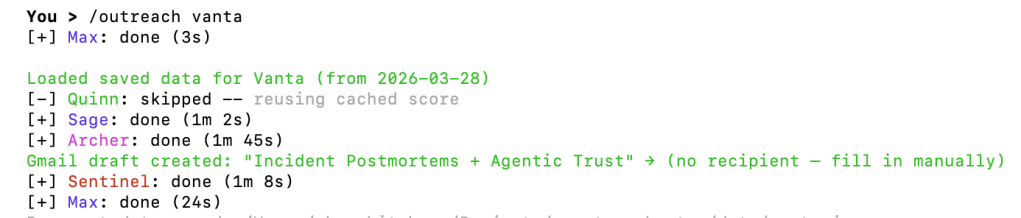
If I am being honest with myself, I felt like a kid in a candy store. I was excited to see what awaited me in Gmail.
I logged in and there it was: Drafts (1). Well actually there were 2. One was a test, 2 was the Vanta email. I clicked on it and was amazed, sort of.
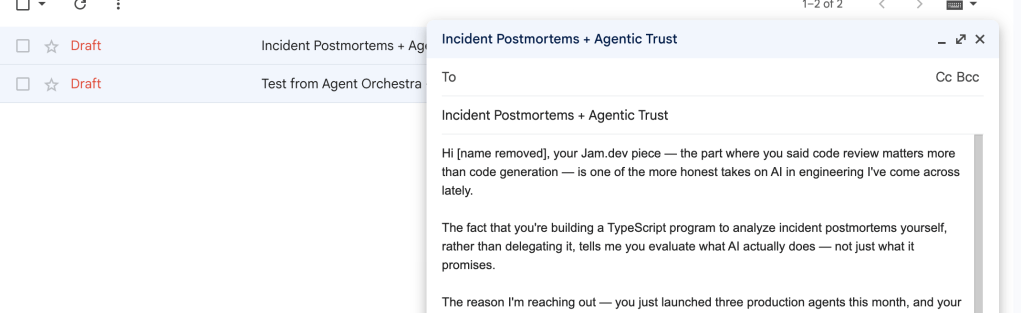
The email was there. The agent had attempted to follow the SMYKM methodology. It had identified an actual person and tailored the message to them, but even with all of the guidance I had given the agent, the draft was not in my voice, included a significant amount of flattery that felt fake, and was just too sales-y.
This demonstrated something that the AI + Sales community has been discussing publicly for some time: AI isn’t great at drafting sales emails. They are too long. They sound like a robot wrote them — lacking human feel.
Case in point, I shared a post on X.com the other day sharing the flow from prospect list to drafted outreach and here is a reply I received: “The voice mismatch is the real killer. When it reads like AI wrote it, the prospect feels the automation, not the human.” And that came from someone building solutions in this exact space.
Clearly, automating cold outreach is a challenge. But does it have to be? I haven’t gone deep enough into this yet to really answer that question.
I see two possibilities:
- With iteration, adding voice-matching skills, sharper frameworks, etc. this can be dialed in to a place that mirrors something I would actually write.
- We get to a place where AI outreach becomes the norm, and sales teams build their agents to be transparent: “I am an AI Agent” and then some form of the SMYKM or we did our homework language that makes it more than just a “hey we want to sell you something, you interested?
I feel like there is a third path where both of these could exist inside of the same process. The AI Agent arriving first (or second) and the sales person’s persona showing up second to support the agent’s presence. Hmmm… something to think about.
But in the instance here, in my Sales Agent Orchestra, I am not discouraged by the initial output of the cold-email agent. It was only the first attempt. I wanted to prove it was possible to add this step to the Orchestra’s workflow.
I believe it can be sharpened and fixed through future iteration. The fact of the matter was — I had taken a part of the sales process, one that would have taken me many hours to complete, and through batch work and a few extra steps was able to go from Customer List to Prospect Lists to Cold Email Outreach for 9 vetted prospects in less than 2 hours of time.
Is it perfect? No.
That is okay. That wasn’t the point of this build. The point was to prove what is possible, discover the gaps, and think about how to plug them.
So what are some of my remaining takeaways?
Validation layers are required.
In building the /profiler agent to create the Ideal Customer Profile based on the customer list I gave it, I failed to include a validation layer into the architecture of this agent. I’ll be honest, the output the Profiler agent created looked great, sounded great, and I took it at face value (at least initially.)
However, as I dug into it — specifically when I dug into the “new buyer persona” it had identified that it had been missing from my initial ICP, I realized it had hallucinated a role that doesn’t exist.
The output said:
“(2) The ‘Chief Knowledge and Innovation Officer’ or equivalent role (a practitioner-turned-innovation-leader with explicit AI mandate) is the most important buyer persona discovered and is entirely absent from the current ICP.”
Sounds great, but there is no such role. I think it was looking at the Chief Intelligence Officer and/or possibly the Chief Information Officer. However, that is not what it delivered back to me.
This showed me two things:
- A validation layer is important for any actionable intelligence.
- Human-in-the-loop is very much necessary in this process, and it is through critical thinking and human judgement that errors like this will be caught.
AI has a place in sales.
The Sales Agent Orchestra clearly demonstrates that AI can augment and enhance an AE’s sales motion!
I believe it makes a salesperson far more effective and enables them to execute in ways that were not possible just a few years ago. Armed with deep intelligence, a salesperson can be better informed as they execute.
Salespeople want to spend more time in front of their customers. They recognize that this is their highest value task. And one that ultimately moves the needle and is the difference between exceeding or missing their quota. And through augmenting their motion with AI, they can be freed from the timesuck from admin and low-value work. And instead they can focus on their highest value task: consulting and advising their customers, building human connection and relationships, and helping their customers solve real business problems.
And further, armed with AI as a collaborative partner, the possibilities feel endless. I built this entire 12-agent architecture without writing a single line of code. Claude and I spent hours discussing the architecture and iterating on a build plan. It was a collaborative team effort: Claude wrote the code while I drove the architecture and UX decisions. And it is through collaboration like this that the sales motion can be entirely reimagined and reengineered in a manner that is far more impactful than anything we’ve seen before today.
 Conversating Claude
Leave a comment